
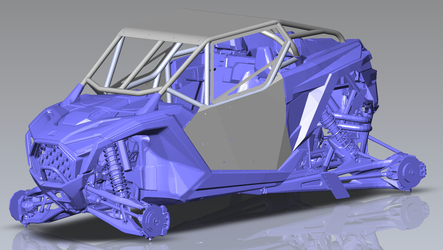
RZR Pro R Factory Boost: 400 HP, $200,000, and Every Spec Polaris Confirmed
Posted by JMerrell on Nov 2nd 2026
Polaris pulled the cover off the RZR Pro R Factory Boost on October 30 at Camp RZR in the Glamis Imperial Sand Dunes — about three hours from our weld bays in Santa Ana. It makes up to 400 horsepower, it starts at $200,000, and unlike most things that show up at a factory racing unveil, you can actually order one.
Here is every spec Polaris confirmed, what changed from the Gen 2 car, and the one line in the press release that matters most if you build or buy cages for a living.
[HERO IMAGE - Polaris RZR Pro R Factory Boost on display at Camp RZR in the Glamis dunes, carbon fiber bodywork and arched roofline visible. Alt: "2027 Polaris RZR Pro R Factory Boost 400 HP race machine unveiled at Camp RZR Glamis"]
What the RZR Pro R Factory Boost Actually Is
This is not a trim level. The RZR Pro R Factory Boost is a purpose-built desert race car that Polaris builds and sells in limited numbers, and it sits above — not in place of — the championship-proven RZR Pro R Factory, which stays in the lineup.
Polaris describes it as "engineered specifically for competition." The RZR Factory Racing team will debut it at the 2027 King of the Hammers, competing in multiple races.
The headline number comes from a race-tuned, turbocharged ProStar Fury 2.0L four-cylinder making up to 400 hp — in Polaris's words, "for commanding holeshots, high-speed passes, and the power to attack demanding terrain."
RZR Pro R Factory Boost Specs Polaris Confirmed
Everything in this list is from the Polaris release. Where a number is not in it, we say so rather than guess.
- Engine – Race-tuned, turbocharged ProStar Fury 2.0L four-cylinder, up to 400 horsepower.
- Price – Starting at $200,000 US MSRP.
- Wheelbase – Extended 6.5 inches to a total of 111 inches, for straight-line stability over rough terrain.
- Cab – Two inches wider for more cockpit space, legroom, and comfort.
- Cage – An all-new cage design, redesigned with driver feedback in mind, delivering added strength.
- Chassis – Reinforced, with increased tubing size across key structural members to add strength and stiffness.
- Shocks – Three-inch internal bypass DYNAMIX DV Live Valve with race-specific components and upgraded one-inch shock shafts.
- Steering – Standard FOX steering damper to absorb large impacts at speed.
- Fuel – 45-gallon (170-liter) fuel cell, up from the previous-generation Pro R Factory's 34-gallon system, extending range beyond 200 miles.
- Electronics – Fully integrated MoTeC package with an upgraded M150 ECU and dual power distribution modules, adding a second PDM over the Gen 2 car.
- Bodywork – Sculpted carbon fiber with an arched roofline, modeled with CFD at speeds exceeding 100 mph.
- How to get one – Available to order now in limited quantities through SCI Distribution, LLC, an exclusive distributor. The first order window closes February 15, 2027.
A few figures circulating this week — 22.25 inches of front travel and 24.5 inches of rear, 74 inches wide, 35-inch BFGoodrich tires on Method BeadGrip wheels, a 4130 chromoly chassis built by Geiser Performance, and roughly 2,600 pounds dry — come from outlet reporting, not from the Polaris release we read. Treat them as unconfirmed until Polaris publishes them.
Factory Boost vs. Gen 2 RZR Pro R Factory
Polaris spelled out the deltas against the Gen 2 car. These are the ones stated outright:
| Area | RZR Pro R Factory Boost | Gen 2 RZR Pro R Factory |
|---|---|---|
| Fuel cell | 45 gal (170 L) | 34 gal |
| Stated range | Beyond 200 miles | Not stated in release |
| Wheelbase | 111 in | 6.5 in shorter |
| Cab width | 2 in wider | Baseline |
| Power distribution modules | Dual PDM | Single PDM |
| Shock shafts | 1 in, race-specific | Not stated in release |
| Cage | All-new design | Baseline |
| Chassis tubing | Increased size, key members | Baseline |
| Starting MSRP | $200,000 | Still available |
The Line That Matters: "Increased Tubing Size Across Key Structural Members"
Strip out the horsepower and the carbon fiber, and look at what Polaris chose to change when it went after 400 hp and 200-mile stages: a reinforced chassis, bigger tubing in the structural members, an all-new cage, and thicker shock shafts.
That is not a styling decision. It is an admission that when you add power and speed, the structure around the driver becomes the limiting part. Polaris did not add 400 hp and leave the tube work alone — because you cannot.
[IMAGE - Close-up of a TIG-welded cage node on a UTV Wolfpack Pro R race cage, showing CNC-cut and CNC-bent tube joints. Alt: "TIG welded 4130 chromoly UTV roll cage node built in-house by UTV Wolfpack"]
We have been making that argument for years, and it is the same reason we build every cage from DOM or 4130 chromoly instead of seam-welded mild steel. If you want the metallurgy, we laid it out in DOM steel vs. seam-welded mild steel for cages — tensile strength roughly 85,000–90,000 psi for DOM against 45,000–55,000 psi for seam-welded mild steel, with no weld seam to crack.
What $200,000 Buys — and What It Doesn't
Most people reading about the Factory Boost are not writing a $200,000 check. They are running a Pro R or a Turbo R they already own, and they just watched the factory tell them that the chassis and cage are where real speed gets paid for.
Here is what that looks like at our prices, on your car:
- Polaris RZR Pro R 2 Seat Race Cage – starts at $3,995 in D.O.M. tubing, delivered complete with welded door frames, door skins, and roof. Every tube CNC cut and CNC bent. Fits 2025 to current Pro R, 2 seat. Add $350 for .120 wall mains and B pillar, $1,500 to step the whole cage to full 4130 chromoly, or $475 for .120 wall mains on the chromoly cage. Window nets are $850 each, driver and passenger.
- Polaris RZR Pro R / Pro S 2 Seat Flat Top Cage – from $999 in D.O.M., with 1.75 x .120 wall mains and a B pillar with 1.75 x .095 cross bars. Available as weld-it-yourself tubes, a full weld-it-yourself kit, or welded and powder coated.
- Polaris Pro R / Turbo R 4130 Chromoly A-Arms – $1,375 to $3,425 depending on uppers, lowers, or the full set. Built from 1.5" x .120 wall USA 4130 chromoly with 3/4-16 chromoly three-piece rod ends for camber and caster adjustment, a 7/8 uniball race bearing, a heat-treated ball joint stud that replaces the factory ball joint, and Delrin bushings in the lower pivot tubes. Lowers give an inch more clearance than factory. Built in the U.S.A.
- Pro R Rear Down Links – $299, and front down links from $199, for the geometry corrections that follow a travel change. Both are on the Pro R suspension page.
- Pro R Four Seat Flat Top Cage – $1,200 to $2,550 for the family cars, listed with the rest of the Pro R cages.
[IMAGE - UTV Wolfpack 4130 chromoly Pro R upper and lower A-arms laid out as a set with hardware, Delrin bushings and ball joint studs. Alt: "UTV Wolfpack 1.5 inch 4130 chromoly Polaris Pro R A-arms with Delrin bushings and 7/8 uniball"]
FAQ
Can I actually buy a RZR Pro R Factory Boost?
Yes, in limited quantities, through SCI Distribution, LLC as an exclusive distributor. Orders are open now and the first window closes February 15, 2027, starting at $200,000 US MSRP.
Is the Factory Boost street or trail legal?
Polaris has not published a legal-use designation for it. The release calls it "engineered specifically for competition," so plan on it being a race car until Polaris says otherwise.
Will the Factory Boost cage fit my Pro R?
No. The Factory Boost rides on a 111-inch wheelbase — 6.5 inches longer than the Gen 2 Factory — with a cab two inches wider and an all-new cage. That is a different car. For your Pro R you want a cage built for your chassis and your seat count.
Is 4130 chromoly always the right call over DOM?
Not always. Chromoly is lighter for the same strength and resists fatigue better, which is why race teams use it. DOM is seamless, tough, more forgiving to work with, and cheaper. For most Pro R owners the honest answer is DOM with .120 wall mains. If you are chasing weight at race speeds, go chromoly.
What wall thickness should I be asking about?
Ask about the mains, not the brand. Our Pro R / Pro S cage runs 1.75 x .120 wall mains with 1.75 x .095 cross bars, and the race cage offers .120 wall mains and B pillar as an upgrade. A cage spec sheet that will not state diameter and wall thickness is telling you something.
Join the Wolfpack.
Polaris just spent 400 horsepower proving that the tube work carries the car. Build yours to match — shop the full Polaris lineup, TIG-welded in-house in the U.S.A. on Miller welders.